 customercare@tripleplay.in


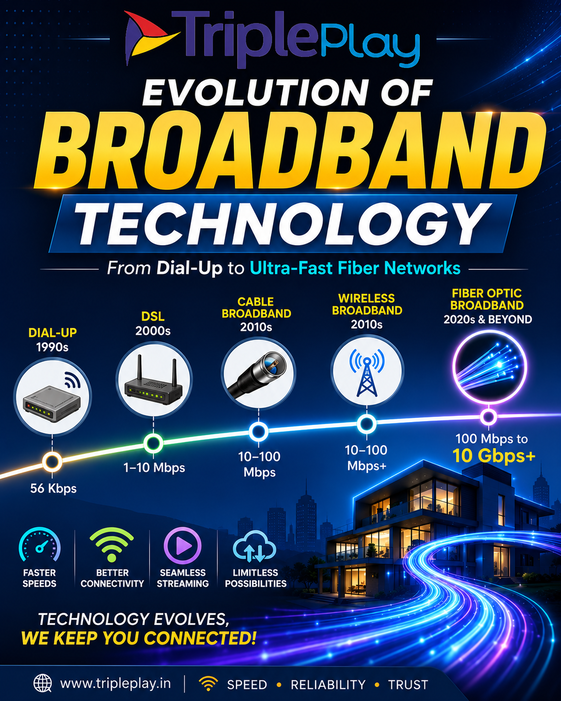
The internet has become an essential part of modern life, powering everything from communication and entertainment to education and business operations. However, the internet experience we enjoy today is the result of decades of technological advancement. The evolution of broadband technology has transformed the way people connect, communicate, and consume digital content.
From the slow and noisy dial-up connections of the 1990s to today's ultra-fast fiber-optic networks, broadband technology has continuously evolved to meet growing demands for speed, reliability, and performance.
At TriplePlay, we understand the importance of staying connected in a rapidly changing digital world. Our advanced broadband solutions help homes and businesses experience the benefits of modern internet technology.
Broadband refers to high-speed internet access that is always available and significantly faster than traditional dial-up connections. Unlike older technologies that occupied telephone lines during internet use, broadband allows simultaneous internet access and voice communication.
Broadband technologies include:
Each generation has improved speed, reliability, and capacity to support increasing digital demands.
To understand modern internet solutions, visit TriplePlay's Broadband Services:
https://www.tripleplay.in/broadband
During the early days of the internet, most users connected through dial-up modems.
Many users still remember the distinctive modem connection sounds before gaining internet access.
While revolutionary at the time, dial-up quickly became insufficient as websites became more sophisticated and multimedia content increased.
These challenges paved the way for broadband technologies.
Digital Subscriber Line (DSL) represented one of the first major broadband breakthroughs.
DSL used existing telephone infrastructure but transmitted data on separate frequencies, allowing users to browse the internet while making phone calls.
Typical DSL speeds ranged from a few hundred Kbps to several Mbps, making web browsing significantly more practical.
DSL enabled:
For many households, DSL marked the beginning of true broadband internet access.
As internet usage expanded, cable providers introduced broadband services using television cable infrastructure.
Cable internet offered significantly higher bandwidth than DSL.
Cable broadband became popular due to its ability to support growing digital content such as:
This technology played a crucial role in the growth of digital entertainment.
The next major advancement was wireless broadband.
Wireless technologies enabled users to access the internet without physical cables connecting devices to networks.
Wi-Fi transformed homes and offices by allowing multiple devices to connect wirelessly.
Benefits include:
Learn more about improving your wireless network experience:
https://www.tripleplay.in
The introduction of 3G, 4G, and later 5G networks expanded internet access beyond homes and offices.
Mobile broadband enabled:
This significantly accelerated global digital adoption.
The most significant advancement in broadband technology has been the development of fiber-optic internet.
Fiber broadband transmits data using light signals through ultra-thin glass fibers.
Fiber technology offers:
Unlike copper-based networks, fiber can handle enormous amounts of data with minimal signal degradation.
Modern fiber connections commonly offer:
At these speeds, users can:
Explore TriplePlay Fiber Broadband Plans:
https://www.tripleplay.in/broadband-plans
Fiber to the Home (FTTH) brings fiber-optic cables directly to residential and commercial properties.
Users experience consistent high-speed internet regardless of network congestion.
Fiber networks are less vulnerable to weather-related disruptions and electromagnetic interference.
As internet requirements grow, fiber infrastructure can support future upgrades without extensive replacement.
FTTH supports:
TriplePlay's advanced fiber infrastructure ensures users enjoy seamless connectivity for today's digital demands.
The progression of broadband technology has reshaped nearly every aspect of modern life.
High-speed internet enables:
Students can access global learning resources from anywhere.
Broadband supports:
Modern organizations rely heavily on fast and stable internet connectivity.
Businesses looking for reliable connectivity can explore:
https://www.tripleplay.in/business-broadband
Streaming platforms have flourished because of broadband advancements.
Users now enjoy:
Without broadband evolution, today's digital entertainment ecosystem would not exist.
Broadband has enabled:
Healthcare providers can deliver services more efficiently and reach remote communities.
Broadband technology continues to evolve rapidly.
Emerging innovations include:
Future networks will provide speeds exceeding 10 Gbps for residential users.
Advanced wireless technologies will enhance mobile connectivity and support IoT ecosystems.
Broadband infrastructure will power:
Millions of connected devices will rely on robust broadband networks for communication and automation.
AI-driven network management will improve:
These innovations will further strengthen digital connectivity worldwide.
Today's households often connect multiple devices simultaneously, including:
As digital dependence increases, broadband quality becomes essential.
A modern broadband provider should offer:
TriplePlay focuses on delivering these benefits through next-generation broadband solutions.
TriplePlay is committed to providing high-performance internet services designed for modern digital lifestyles.
✔ High-speed fiber broadband
✔ Reliable network performance
✔ Low-latency connectivity
✔ Plans for homes and businesses
✔ Excellent customer support
✔ Future-ready infrastructure
Whether you need internet for work, education, entertainment, or business growth, TriplePlay offers broadband solutions that keep you connected.
Visit TriplePlay today:
https://www.tripleplay.in