 customercare@tripleplay.in


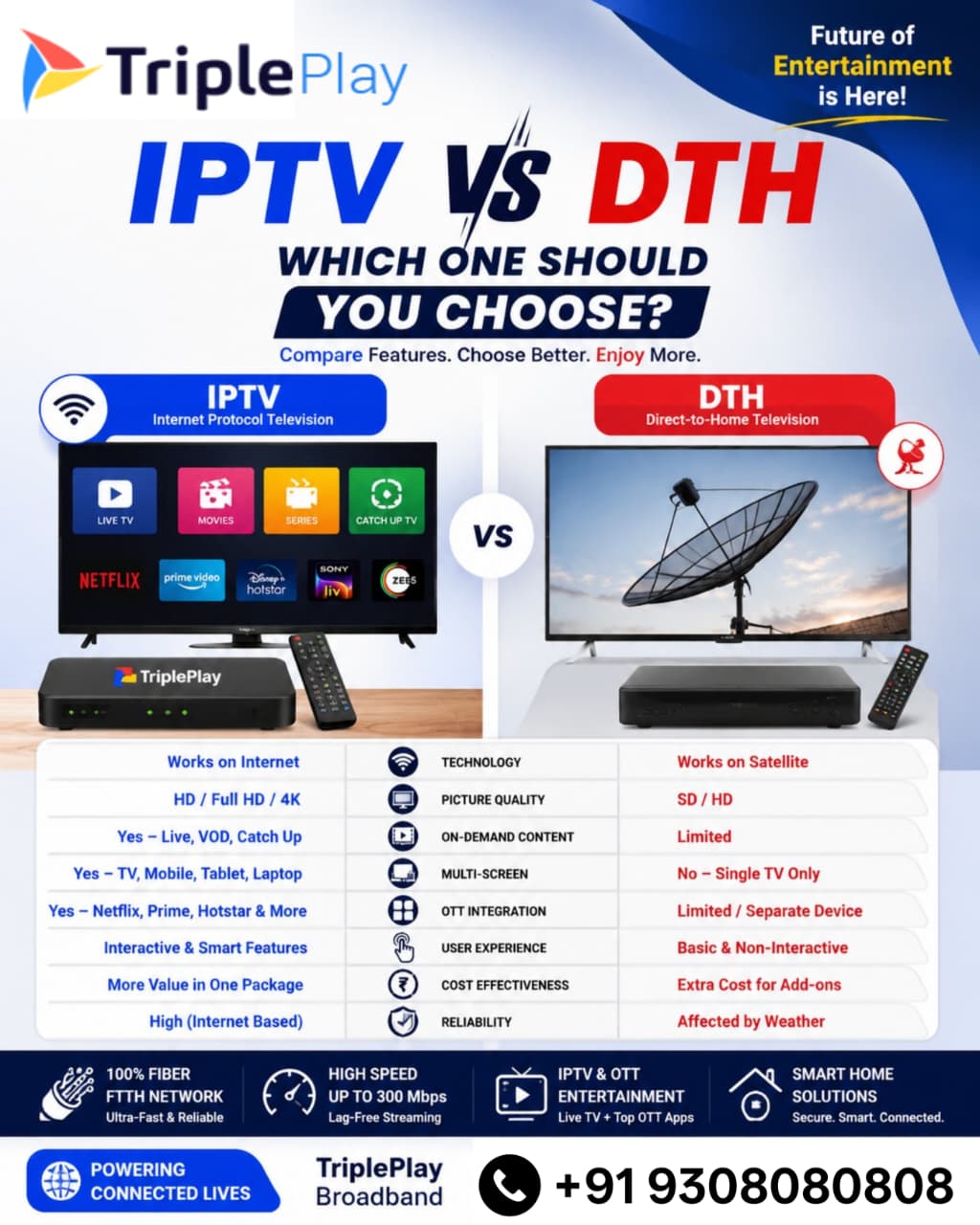
Television entertainment has evolved dramatically over the past decade. Gone are the days when families had only a handful of channels to choose from. Today, viewers want high-definition content, on-demand entertainment, multi-screen access, and seamless integration with OTT platforms.
This shift has led to a growing debate: IPTV vs DTH – which one should you choose?
While DTH (Direct-to-Home) television has been a popular choice for years, IPTV (Internet Protocol Television) is rapidly transforming how people consume entertainment. With better picture quality, interactive features, and integration with high-speed fiber internet, IPTV is increasingly becoming the preferred choice for modern households.
In this comprehensive guide, we'll compare IPTV and DTH across multiple factors including technology, picture quality, pricing, reliability, features, and overall user experience to help you make an informed decision.
IPTV stands for Internet Protocol Television. Instead of receiving television signals through satellites, IPTV delivers television channels and content through a broadband internet connection.
This means your TV content is transmitted over a high-speed fiber network, allowing access to live TV, video-on-demand, catch-up TV, OTT platforms, and interactive services.
TriplePlay offers advanced IPTV services powered by its fiber broadband network, delivering a modern entertainment experience for homes and residential communities.
Learn more:
https://www.tripleplay.in/services/iptv
Unlike traditional television services, IPTV combines television, internet, and digital entertainment into a single integrated platform.
DTH (Direct-to-Home) television delivers television signals directly from satellites to a dish antenna installed at the customer's location.
Popular DTH providers in India use satellite technology to broadcast channels across the country.
The setup generally includes:
Satellite Dish
Set-Top Box
Remote Control
Subscription Package
Although DTH remains widely used, it has certain limitations compared to modern IPTV solutions.
IPTV works using:
Fiber Internet
Broadband Networks
IP-Based Content Delivery
Cloud Infrastructure
Since content is delivered through internet protocols, IPTV can support interactive features, on-demand content, and multi-device streaming.
TriplePlay's Fiber-to-the-Home (FTTH) network provides the high-speed connectivity necessary for seamless IPTV experiences.
Explore Fiber Broadband:
https://www.tripleplay.in/services/fiber-internet
DTH depends on:
Satellites
Dish Antennas
Weather-sensitive signals
Fixed television connections
The quality of service often depends on signal strength and environmental conditions.
IPTV delivers:
HD Channels
Full HD Content
4K Streaming Support
Stable Picture Quality
Because content is delivered over fiber internet, picture quality remains consistent without signal degradation caused by weather.
DTH offers:
SD Channels
HD Channels
Limited 4K availability
However, heavy rain, storms, and cloud cover can sometimes impact signal reception.
For households seeking superior viewing quality, IPTV offers a clear advantage.
Modern IPTV platforms provide:
Live TV Channels
Video-on-Demand
Catch-Up TV
OTT Applications
Interactive Content
Viewers can enjoy television content alongside platforms such as streaming services without switching devices.
TriplePlay IPTV integrates entertainment and connectivity into a single ecosystem.
Explore IPTV Services:
https://www.tripleplay.in/services/iptv
DTH primarily focuses on:
Linear TV Channels
Fixed Channel Packages
While some providers offer OTT bundles, the integration is often less seamless than IPTV.
The flexibility of IPTV provides significantly more content options.
One of the biggest advantages of IPTV is its ability to support multiple devices.
Users can watch content on:
Smart TVs
Smartphones
Tablets
Laptops
Desktop Computers
Family members can enjoy different content simultaneously.
DTH generally limits viewing to televisions connected to set-top boxes.
Additional TVs require separate connections and hardware.
Modern households increasingly expect multi-device access.
IPTV allows users to:
Watch content anytime
Pause live TV
Rewind programs
Access recorded shows
Stream movies instantly
This provides a personalized entertainment experience.
Most DTH platforms primarily focus on scheduled programming.
While some providers offer recording features, they remain limited compared to IPTV.
On-demand viewing has become a major consumer preference.
IPTV generally requires:
High-Speed Internet Connection
IPTV Set-Top Box or Smart TV App
Wi-Fi or Ethernet Connection
TriplePlay provides end-to-end installation and support for fiber broadband and IPTV services.
Explore Connectivity Solutions:
https://www.tripleplay.in
DTH requires:
Satellite Dish Installation
Cable Routing
Set-Top Box
Signal Alignment
Installation can become challenging in certain apartment complexes and urban locations.
The setup is cleaner and more scalable.
IPTV operates over internet infrastructure.
Therefore:
Rain does not affect television signals
Storms do not interrupt satellite reception
Signal quality remains consistent
Satellite signals can be affected by:
Heavy Rain
Thunderstorms
Dense Cloud Cover
This may result in temporary interruptions.
Reliability during adverse weather conditions is a significant advantage.
Modern homes increasingly rely on connected technologies.
TriplePlay offers solutions including:
Smart Home Automation
Video Door Phones
CCTV Surveillance
Wi-Fi Hotspots
Access Control Systems
Learn More:
https://www.tripleplay.in
IPTV integrates naturally into these connected ecosystems.
DTH, on the other hand, remains largely independent from smart home environments.
IPTV is built for connected living.
IPTV typically combines:
Television
Broadband
OTT Services
into one package.
This often provides better value for money compared to maintaining separate subscriptions.
DTH users may need separate subscriptions for:
Television
Broadband
OTT Platforms
Overall costs can increase depending on viewing preferences.
Bundled entertainment services often deliver greater value.
Interactive Interface
Voice Search
Personalized Recommendations
OTT Integration
Multi-Screen Support
On-Demand Content
Future-Ready Technology
Works without internet
Familiar setup
Widely available
However, modern entertainment consumption increasingly favors flexibility and personalization.
IPTV aligns better with today's digital lifestyles.
A high-quality IPTV experience depends on a reliable internet connection.
TriplePlay's FTTH network offers:
Speeds up to 300 Mbps
Unlimited Data Plans
Low Latency
High Reliability
Consistent Performance
Explore Fiber Plans:
https://www.tripleplay.in/services/fiber-internet
Fiber connectivity ensures smooth streaming, faster channel switching, and uninterrupted entertainment.
Many modern residential communities are replacing traditional television infrastructure with integrated IPTV systems.
Benefits include:
Centralized Management
Better Channel Distribution
Enhanced Resident Experience
Future-Proof Infrastructure
TriplePlay provides digital infrastructure solutions for residential societies and smart communities.
Learn More:
https://www.tripleplay.in
IPTV is ideal for:
Smart Home Owners
OTT Users
Streaming Enthusiasts
Modern Families
Work-from-Home Professionals
Tech-Savvy Viewers
Residential Communities
If you already use fiber broadband, IPTV becomes an obvious upgrade.
DTH may still be suitable for:
Remote Locations
Areas with Limited Broadband Availability
Users Seeking Basic Television Services
However, as fiber networks expand across India, IPTV continues to gain popularity.
When comparing IPTV and DTH across technology, picture quality, flexibility, features, reliability, and future readiness, IPTV emerges as the clear winner.
| Feature | IPTV | DTH |
|---|---|---|
| Picture Quality | ✅ Excellent | ✔ Good |
| Weather Resistance | ✅ Excellent | ❌ Limited |
| Multi-Screen Access | ✅ Yes | ❌ No |
| Video On Demand | ✅ Yes | ❌ Limited |
| OTT Integration | ✅ Yes | ❌ Limited |
| Smart Home Compatibility | ✅ Yes | ❌ No |
| Future Ready | ✅ Yes | ❌ Limited |
For households seeking a modern entertainment experience, IPTV offers unmatched convenience, flexibility, and value.
With TriplePlay's Fiber Broadband and IPTV ecosystem, users can enjoy high-speed internet, premium entertainment, OTT integration, and smart home connectivity through a single provider.
Explore TriplePlay IPTV:
https://www.tripleplay.in/services/iptv
Discover Fiber Broadband:
https://www.tripleplay.in/services/fiber-internet
Visit TriplePlay:
https://www.tripleplay.in